How to Slow Skin Ageing | Anti-Ageing Skincare Ireland | Dr.EvOl.
How to Slow Down Skin Ageing: A Professional Approach to Younger, Healthier Skin
Skin ageing is inevitable. Premature skin ageing is not.
As an aesthetic practitioner, one of the questions I hear most often is: “What can I do to keep my skin looking younger for longer?”
There is no single cream, injection or procedure that can stop the ageing process. But modern aesthetic medicine and professional skincare give us many ways to influence how the skin ages, protect it from preventable damage and maintain its firmness, hydration and healthy appearance for longer.
The most effective strategy is not to wait until deep wrinkles, pigmentation and significant loss of elasticity appear.
It is to understand why the skin ages and work with these processes before they become strongly visible.
Why Does Our Skin Age?
Skin ageing is a complex biological process influenced by both internal and external factors.
Intrinsic ageing happens naturally with time. Cellular renewal becomes slower, the structure of the dermis changes, and the production and organisation of substances responsible for skin firmness and elasticity gradually decline.
Extrinsic ageing is influenced by factors such as UV exposure, smoking, pollution, stress and lifestyle.
Among these factors, chronic exposure to ultraviolet radiation is particularly important. It contributes to what we call photoageing — premature ageing associated with cumulative sun damage.
This is why two people of the same biological age can have very different-looking skin.
Genetics matter, but so do our environment, habits and skincare choices.
Skin Ageing Is More Than Wrinkles
When we talk about ageing, people usually think about wrinkles first.
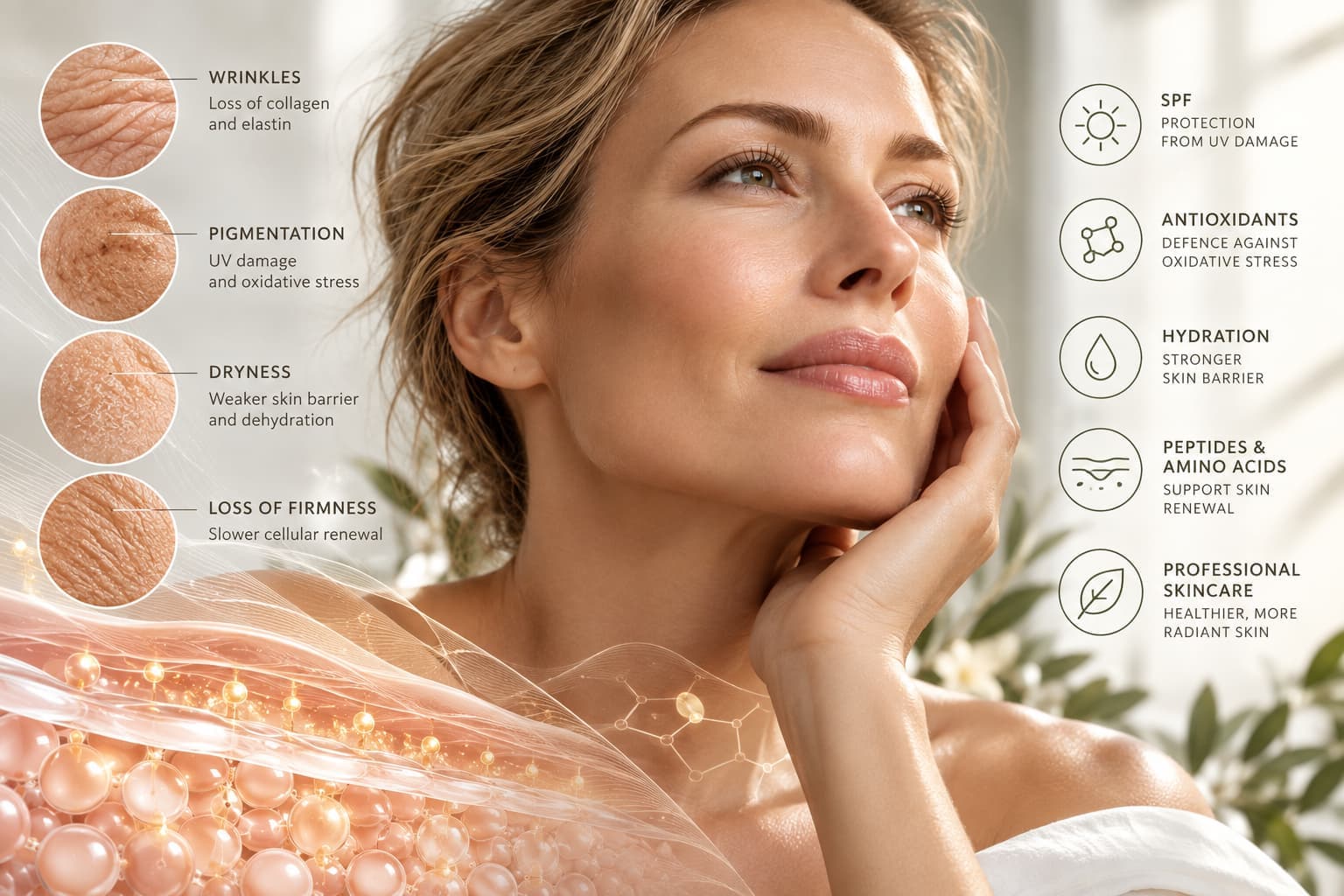
But ageing affects many characteristics of the skin.
Over time, you may notice:
-
fine lines and deeper wrinkles;
-
reduced firmness and elasticity;
-
changes in facial contours;
-
dryness and dehydration;
-
dullness and loss of radiance;
-
uneven skin texture;
-
pigmentation and uneven skin tone;
-
increased sensitivity;
-
slower skin recovery.
This is why I never approach anti-ageing treatment by asking only: “How do we remove this wrinkle?”
The more useful question is:
“What is happening to this skin, and what does it need now?”
Collagen: Why Skin Gradually Loses Firmness
Collagen is one of the major structural proteins responsible for the strength and support of the skin.
As we age, collagen production gradually declines and the organisation of existing collagen changes. Long-term UV exposure can accelerate collagen degradation.
Elastin and other components of the extracellular matrix are affected as well.
The result is familiar: skin gradually becomes thinner, less elastic and less resistant to gravitational and mechanical changes.
This is why effective anti-ageing skincare and aesthetic treatments should not focus exclusively on filling or disguising wrinkles.
We also need to think about the quality and condition of the skin itself.
Oxidative Stress and Premature Skin Ageing
Another important factor is oxidative stress.
Our cells naturally produce reactive oxygen species. The body has antioxidant defence systems to control them, but excessive UV exposure, pollution, smoking and other environmental factors can increase oxidative stress.
Over time, this can contribute to damage affecting cellular structures and components of the extracellular matrix.
This is one reason antioxidants are frequently incorporated into modern professional skincare.
Vitamins and other antioxidant ingredients can form part of a broader strategy designed to protect the skin and support healthy ageing.
Never Underestimate Hydration
Sometimes a patient believes that their skin has suddenly “aged”, when dehydration is making fine lines, roughness and dullness much more visible.
Healthy-looking skin needs an effective protective barrier.
When the epidermal barrier is compromised, the skin loses water more easily and can become dry, tight, sensitive and irritated.
For this reason, hydration and skin barrier support are fundamental parts of anti-ageing skincare.
A sophisticated anti-ageing routine does not necessarily mean using the largest possible number of active ingredients.
Sometimes restoring the barrier and correcting dehydration can make a remarkable difference to how the skin looks and feels.
Which Skincare Ingredients Can Help Ageing Skin?
There is no single “best” anti-ageing ingredient. Different substances perform different functions, and the right combination depends on the condition of the skin.
Some of the most important categories include:
Antioxidants
Antioxidants help support the skin against oxidative stress caused by environmental factors.
Vitamin C is particularly well known in skincare and can also play a role in supporting collagen synthesis.
Retinoids
Retinoids are among the most extensively studied topical ingredients for photoaged skin. Depending on the specific product and concentration, they can help improve the appearance of fine lines, pigmentation and skin texture.
However, they are not suitable for every person or every situation and need to be introduced appropriately.
Peptides
Peptides are short chains of amino acids. Different peptides may perform different functions in cosmetic formulations and are widely used in modern anti-ageing skincare.
Amino Acids
Amino acids are naturally present in the skin and are involved in numerous biological processes. They can also contribute to hydration and skin conditioning.
Lipids and Barrier-Supporting Ingredients
Healthy skin requires an effective barrier. Appropriate lipid-rich ingredients can help reduce moisture loss and improve comfort, particularly in dry or mature skin.
Humectants
Ingredients that attract and retain water can help improve hydration and temporarily make the skin appear smoother and more supple.
The important point is that more active ingredients do not automatically mean better skincare.
The formulation, concentration, combination of ingredients and suitability for your individual skin are all important.
SPF May Be Your Most Important Anti-Ageing Product
If someone asks me where to begin with preventing premature skin ageing, daily sun protection is one of the first things I discuss.
You can invest in sophisticated creams, serums and aesthetic procedures, but repeated unprotected UV exposure works against those efforts.
Broad-spectrum sunscreen should therefore be considered part of an anti-ageing strategy rather than something reserved only for holidays or sunny summer days.
Prevention is always easier than trying to correct years of accumulated photodamage.
Professional Skincare: Why I Use GERnétic
In my practice, I believe that good skincare should support the skin rather than simply create a temporary cosmetic effect.
This is one reason I work with GERnétic professional skincare.
GERnétic's philosophy is based on a comprehensive approach to skin condition, incorporating concepts from cellular biology and using combinations of active ingredients such as amino acids, peptides, vitamins, trace elements, plant extracts and lipid components.
What I particularly value is the possibility of personalising the programme.
I do not believe that every woman over 40 needs the same cream or that every patient with a wrinkle requires the same treatment.
One person may need intensive barrier restoration and hydration. Another may need support for pigmentation or loss of firmness. Someone else may have mature skin that is simultaneously sensitive or prone to breakouts.
Professional skincare should reflect these differences.
Skincare or Aesthetic Procedures — Which Is More Important?
I am often asked whether professional skincare can replace aesthetic procedures.
The answer is that they have different roles.
Good skincare works every day. It helps maintain hydration, protect the skin barrier, provide appropriate active ingredients and reduce preventable environmental damage.
Aesthetic treatments can address concerns that topical skincare alone cannot fully correct.
Depending on the individual, a professional anti-ageing plan may include:
-
professional facial treatments;
-
chemical peels;
-
mesotherapy or biorevitalisation;
-
treatments for facial wrinkles;
-
dermal fillers;
-
collagen-stimulating approaches;
-
thread lifting;
-
individually selected professional home skincare.
The objective should not be to perform as many procedures as possible.
The objective is to select the right treatment at the right time for the right patient.
Why I Prefer Natural-Looking Results
For me, modern aesthetic medicine should not erase individuality.
A good anti-ageing result should not make every face look the same.
The goal is to improve skin quality, soften the signs of ageing where appropriate and maintain harmonious facial proportions while preserving natural expression.
You should still look like yourself — simply fresher, healthier and more rested.
This is why my approach combines professional skincare with aesthetic treatments only when they are appropriate for the individual patient.
When Should You Start Anti-Ageing Skincare?
There is no universal age.
Anti-ageing should not begin on your 30th, 40th or 50th birthday simply because a cosmetic label says so.
Prevention can begin much earlier with basic habits:
sun protection + appropriate cleansing + hydration + barrier support + carefully selected active skincare.
As the skin changes, the programme can change with it.
Later, professional treatments can be introduced when there is a genuine indication rather than simply because a certain procedure is fashionable.
The Biggest Anti-Ageing Mistake
One of the biggest mistakes is waiting until ageing becomes very pronounced and then trying to correct everything at once.
Healthy ageing is a long-term process.
I prefer the following philosophy:
Protect → Prevent → Support → Correct → Maintain
Protect the skin from avoidable damage.
Prevent premature ageing where possible.
Support its natural functions with appropriate skincare.
Correct specific concerns when necessary.
Maintain the result consistently.
This is far more realistic than searching for a miracle treatment that promises to reverse years of ageing overnight.
Healthy Ageing, Not “Anti-Ageing”
Perhaps we should even reconsider the expression anti-ageing.
Ageing itself is not a disease.
The goal of aesthetic medicine should not be to make a 50-year-old woman look 25.
For me, the goal is healthier ageing: maintaining good skin quality, balanced facial proportions, confidence and a natural appearance at every stage of life.
Professional skincare, sun protection, lifestyle and modern aesthetic treatments can all contribute — but they should be used intelligently and individually.
The best aesthetic result is not a different face. It is a healthier, fresher and more confident version of you.
Professional Skin Consultation in Ireland
If you are concerned about wrinkles, pigmentation, loss of firmness, dehydration or other signs of skin ageing, the first step should be understanding what your skin actually needs.
During a professional consultation, we can assess your skin condition, discuss your concerns and create an individual plan combining appropriate professional skincare and aesthetic treatments.
Rather than following trends or choosing treatments based on age alone, we can build a strategy designed specifically for your skin, your face and your goals.
Book your consultation with Dr.EvOl and discover a personalised approach to healthy, natural-looking ageing.